
Strap in. This elder millennial is about to yell at some clouds.
I’ve been feeling this for quite a while and pretty deeply in recent years — the idea that we’ve lost something magical about the “old” internet as we barrel towards a more AI corrupted dystopic enabled future.
Who am I kidding? We’re already there, making ourselves at home and mixing ourselves a drink.
The sense of agency — as discussed in the video essay linked below — that we gained in the 90s by moving away from information and entertainment happening “at us” via traditional television and radio programming and towards the utopian vision of the World Wide Web, where we were able to (nay, had to) make decisions about what we did or consumed online, has been slipping away from us for some time. However, the past few years of AI development have felt like a rapidly accelerating slide back into the days of cable TV and radio.
Yes, you could change the channel or tune into a different station in the old days, but that was the extent of your choices.
Yes, you will soon be able to select a different “search engine” or AI model in the near future, but that will be the extent of your choices.
HTML is now “artisanal”
It’s possible that this has been true for a long time and I can only now begin to cobble together my thoughts about it.
For years I have dabbled in maintaining my own “hand crafted” websites, starting on our 486 Windows 95 PC in the old family computer room back in 1996. In those days, much like the “family radio” held a central place in the home nearly a century earlier, it was pretty typical for homes to have a “family computer” that everyone in the house used to access the internet, check email, replay the same shareware levels of your favorite game, lurk in IRC chat rooms, work on your fan fiction short stories, manage personal finances, etc.
Being a fan of “retro” technology and prone to wallowing in feelings of nostalgia, I occasionally update my “old school” web site, Luc’s Old School Homepage, by writing HTML code in a text editor, just like I did back in high school. There is something that just feels “good” about writing HTML code, even when I’m doing it through a web-based editor and uploading it via a modern platform like cPanel File Manager. If I’m really feeling like a purist, I’ll fire up a Windows 95 image in Dosbox to view the site in good ole’ Internet Exploder 4 (links provided for you kids who don’t know what I’m talking about and, no, that last one isn’t a typo).
If you’re interested, visit my other old-school website, Bluebox42, on Neocities, a really cool community similar to the old GeoCities.
I’ve been writing HTML long enough that even a flourish of embedded CSS feels a little “new” and needlessly complex. Give me a “<strong>” or “<em>” tag any day. How much damn formatting do you need to get your point across? I don’t want to bloat my beautiful unsullied web page with all that extra stuff. Anyway, I need to reserve all that space for the beautifully animated GIF images and backgrounds that will adorn my Geocities, Tripod, or AngelFire homepage.
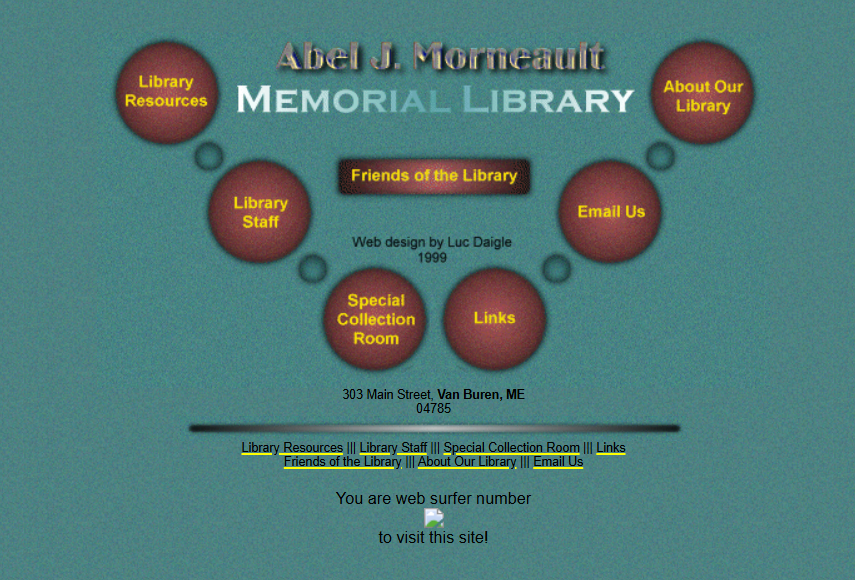
Here is a website I built for my local library back in 1999 (Abel J. Morneault Memorial Library). I took a screenshot just in case the site goes down someday. In fact, I’m surprised that it is still available after all these years. I wasn’t skilled enough to encode the layout of the buttons in my HTML file manually, so I used a freeware imaging editing program (can’t remember which one) and an image mapping tool to generate the hyperlinks in this abstract and severely nineties looking menu.
To this day, I still carry the shame I felt for “cutting corners” — which I realize is completely ridiculous.
The Current Concern About AI Search Tools
I’ve been reading articles and watching video essays regarding people’s concerns over the most recent AI developments, most notably Google’s announcement regarding their new integrated AI search engine. A recurring theme in this coverage is the idea that people will eventually stop creating websites since the major search engines will prioritize AI-generated responses over links to the websites that provide the raw material for those responses. As the pace of new website creation begins to slow, a proportional amount of AI-generated content will become fodder for the further growth of large language models. Eventually, we’ll all be consuming the informational equivalent to Soylent Green — the recycled products of a monster that has long since eaten everything available and can only feed on itself.
The old promise of the democratization of information will last be seen wandering lazily in an empty meadow that once saw the dawn of the “information age”, now dim in the twilight of the old internet, where it will soon diminish into the misty and murky forests of human culture. A stillness will settle over that bygone era, disturbed only by a few aging Xennials as they type furiously into their blogs and bulletin board forums, quietly raging against the dying of the light.
We will yearn to disconnect, only to find that there is no longer a “Disconnect” button to sever our connection, nor is there anything to see but the output of a spigot of slop from which someone has removed the shut-off valve.
Wow, this got pretty bleak. Sorry about that. Maybe go outside and touch grass for a bit if you’re feeling a bit overwhelmed, as the kids say.
The ghost of blog posts past
Then again, this isn’t the first time I’ve been known to rail against emerging trends in cyberspace. Twenty years ago, I was ranting about abbreviated text and emoticons typical in Instant Messaging and how it somehow foretold the downfall of online discourse. I guess instead of willfully reducing our choice of words, we are relegating our agency to read or otherwise consume anything at all in favor of predigested AI generated summaries.
Or maybe I’m just being paranoid 🙂
Leave a Reply