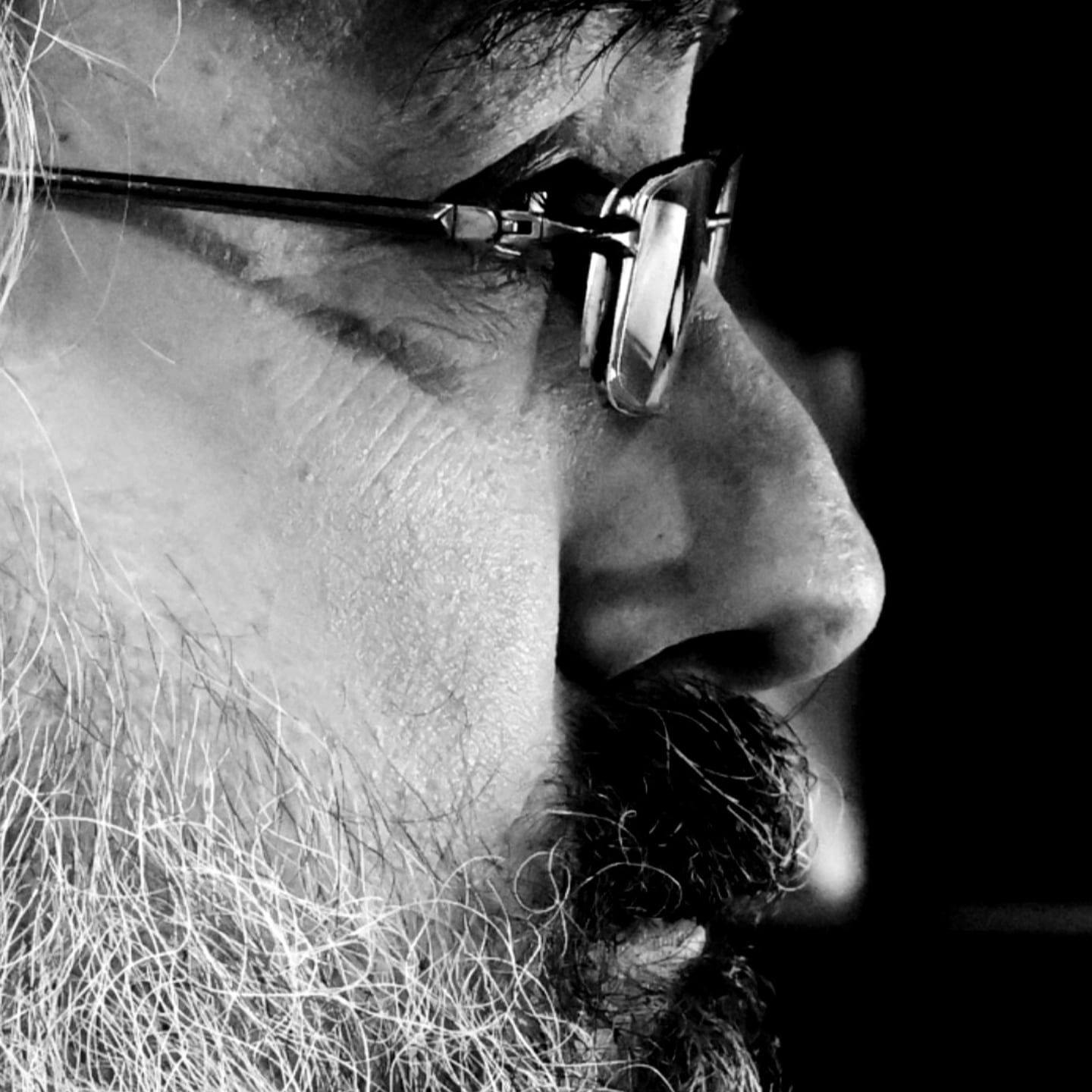

Far out in the uncharted backwaters of the unfashionable end of Caribou, a young man spends too much time alone with his books.
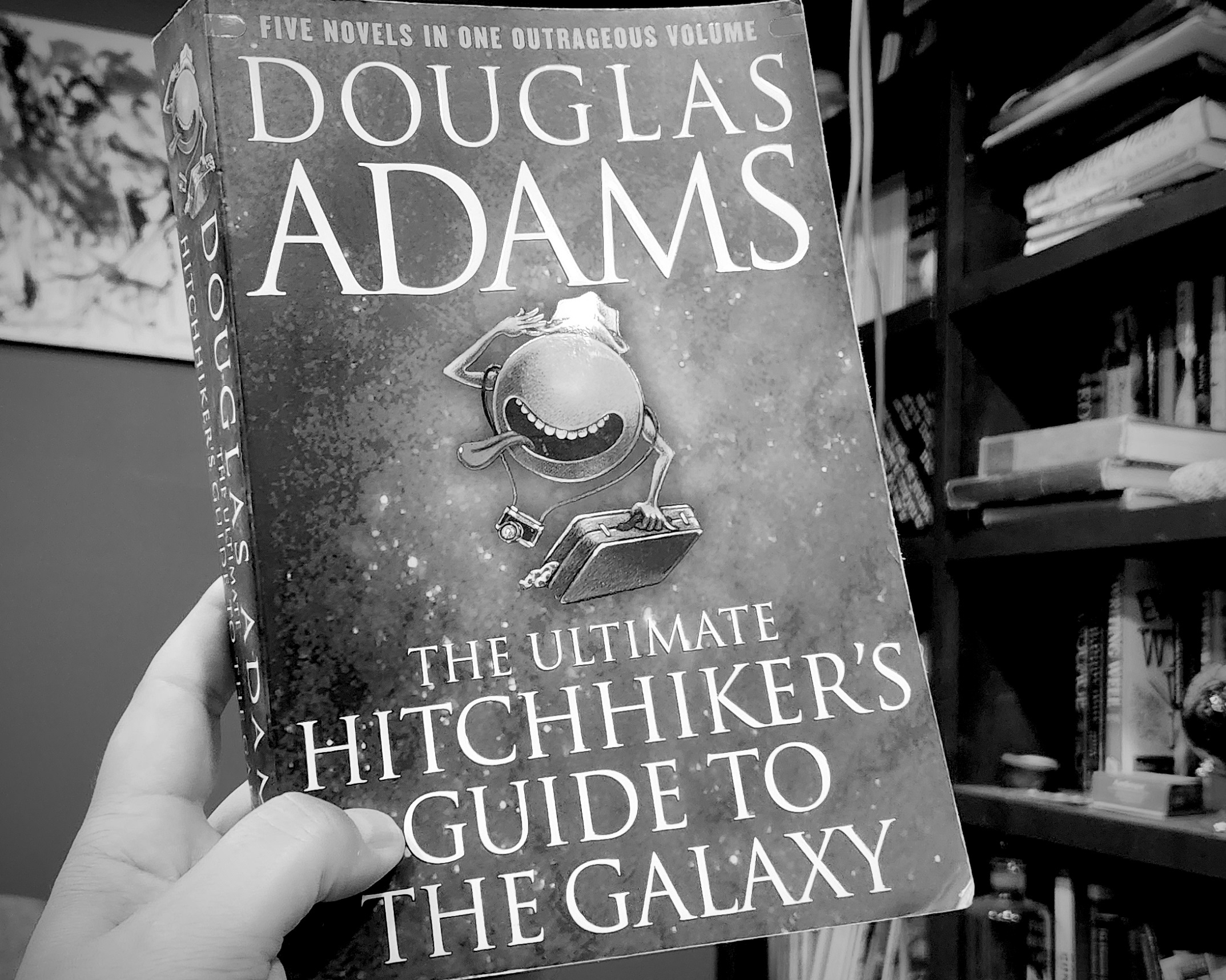
Years ago, in my early twenties, I read The Ultimate Hitchhiker’s Guide to the Galaxy, which combines Douglas Adam’s classic five-part “trilogy” into one volume (famously known as a “trilogy in five parts”). The work is a novelization of the radio series Adams originally wrote for BBC Radio 4.
In those days, I was living alone in my apartment and spent most of my free time either reading and drinking, walking and drinking, or watching movies and drinking. I had meager aspirations to be a lonely tortured writer but only managed to be a lonely tortured drinker who occasionally wrote something.
This was all before I had a family and everything. Twenty years later I still have a twinge of the ole’ functional-alcoholism and enjoy writing, but I’m not the Ambrose Bierce wanna-be I once was.
Blogs were just picking up speed in the early ‘aughts and social media was still in it’s awkward “MySpace” phase. I staked my claim online with my own blog where I would chronicle my adventures walking around The County or playfully lash out at the rising popularity of emoticons in instant messaging apps.
HHGTTG, as well as other writings by Adams, stood out to me among all other works. It wasn’t the first piece of satire that I had come to love, but it was the first that was a pure joy to read. It still is.
The story is satirical science-fiction and centers around a man named Arthur Dent who awakens one morning to find his home in rural England is about to be demolished to make way for the construction of a bypass. Minutes after his house is bulldozed, the entire planet is unexpectedly demolished to make way for the construction of a hyperspatial express route. Slightly hung over and still in his dressing gown (we would call it a bathrobe or housecoat in the US), Arthur escapes an exploding Earth and is dragged across the galaxy by his friend, who is revealed to be a non-human from somewhere in the vicinity of Betelgeuse and working as a writer for the Hitchhiker’s Guide to the Galaxy (like Wikipedia for galactic travelers).
Here is a summary of one of my favorite parts of that book.
Following the complete annihilation of his home planet and countless other misadventures, Arthur wanders the galaxy despondently, searching for love and meaning in a seemingly cruel and mocking universe. Having long lost his way and seeking any sort of guidance (as well as a warm bath and a cup of tea), he finds himself on a planet populated entirely by oracles and soothsayers.
A rack in the spaceport tourism booth contains a brochure which mentions a prophet that may help. It promises clear, practical advice and a complimentary customized prayer for your special needs.
Arthur finds the wizened old prophet in a village consisting of tall poles topped with platforms covered in bird droppings. At the top of one of these poles, Arthur asks the old man for guidance.
[dialog is quoted directly from HHGTTG]
Arthur: “Do you have any advice for a traveler?”
Prophet: “Yes. Get a beach house. It gives you somewhere to go.”
Arthur, confounded and weary from his travels, waits patiently for clarification. Instead, he gets the following.
Prophet: “A beach house doesn’t even have to be on the beach. Though the best ones are. We all like to congregate at boundary conditions. Where land meets water. Where earth meets air. Where body meets mind. Where space meets time. We like to be on one side, and look at the other.”
Unimpeded by Arthur’s visible muddlement, he goes on:
Prophet: “You cannot see what I see because you see what you see. You cannot know what I know because you know what you know. What I see and what I know cannot be added to what you see and what you know because they are not of the same kind. Neither can it replace what you see and what you know, because that would be to replace you yourself.”
And finally:
Prophet: “Everything you see or hear or experience in any way at all is specific to you. You create a universe by perceiving it, so everything in the universe you perceive is specific to you.”
I won’t spoil anything by telling you whether Arthur actually got a beach house or not.
To this day, that part of the book has probably been the closest I’ve ever come to having a religious experience. Not because any part of it revealed some hidden truth of the world or claimed to provide concrete reasoning or evidence of anything (like some other “greatest story ever told” books I could name…)
The seers words resonated with me because it laid out, in a weaving sort of way, why we might often have difficulty “understanding” each other. More specifically, it helped me understand my difficulty with understanding other people.
I believe it’s true that we love boundaries. We create them everywhere. We create boundaries between ourselves and the one’s near us. We then create further boundaries between those near us and everyone else. At the very minimum we appear to need an “us” and “them” which we can then separate with more boundaries.
We live and die by our boundaries.
But we don’t stop there. What of the boundaries between ideologies that seem to dominate our daily lives? We all seem to be sitting on the front porches of our beach houses, waving amiably or shaking our fists angrily at the other beach houses we think we can see across the water.
And what of our individual universes centered around our individual perspectives that exist only in our heads and can never truly be experienced by anyone else? No wonder communication is hard — we’re so friggin’ complicated.
Despite our complicated and messy tendency to raise imaginary boundaries everywhere, I think it’s worth working towards having a better understanding of each other’s individual perspectives and living with the knowledge of everyone’s unique (in the universal sense) point of view.
Leave a Reply